
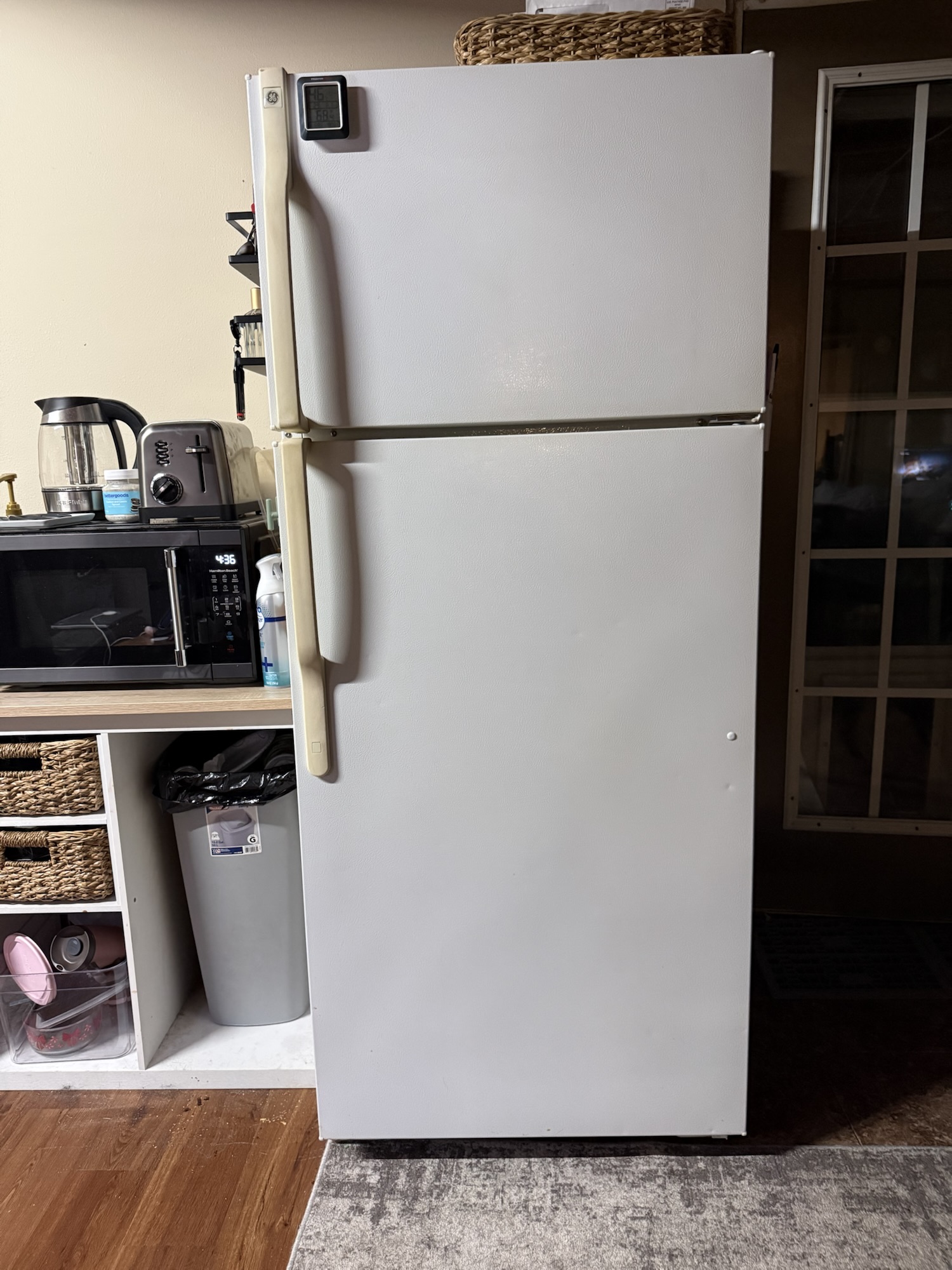
Well, it appears that I may have been a little premature in writing the obituary for our basement refrigerator.
For those who followed along with my 4:15 AM reflections on the apparent passing of a twenty-some-year-old General Electric refrigerator, I have an update. Apparently, the refrigerator had not actually reached the end of its useful life. It was simply experiencing a temporary interruption in its responsibilities, complicated by a door that had been left ever so slightly open.
Unfortunately, I was unaware of this distinction when I discovered the warmer-than-expected contents of the freezer.
At that hour, with very little sleep and a mind that had already spent much of the night exploring grief, family relationships, and the passage of time, I reached what seemed like a perfectly reasonable conclusion. The refrigerator had finally surrendered after more than two decades of service, approximately twelve of those years spent with our family.
And because this is Behind the Puddle, I somehow managed to turn a mechanical failure into a reflection on belonging, memories, and the ordinary things that quietly accompany us through life. In my defense, the food really was getting warm.
I wasn’t particularly interested in discovering how much food we could afford to lose, so I began transferring the contents into our large basement freezer. Had the only available space been upstairs in our main freezer, I suspect there would have been considerably more discussion about the financial implications of what could reasonably be saved. Fortunately, the basement freezer offered a much more convenient solution at an hour when convenience was becoming increasingly important.
By the time Brian had an opportunity to investigate, I had already accepted the refrigerator’s retirement, reflected on its contributions to our family, and shared its story with the world.
Brian, however, approached the situation somewhat differently.
Rather than immediately accepting my conclusion, he checked the door, placed a thermometer inside, adjusted the temperature control, and gave the refrigerator an opportunity to reset itself. He explained that it might have been going through a normal defrost cycle when I discovered the problem. Combined with a door that hadn’t been completely closed, the appliance may simply have been unable to maintain its usual temperature.
Then he suggested we wait and see what happened. Within a few minutes, there was a familiar, quiet hum. And just like that, the refrigerator was apparently back in business.
I suppose this is one of those moments when being married to someone with considerably more mechanical knowledge and a much more practical approach to household problems proves especially beneficial. While I was contemplating the emotional significance of an appliance’s departure, Brian was determining whether the appliance had actually departed.
It turns out that distinction matters.
The freezer is cold again, the refrigerator is functioning, and our old General Electric has returned to its responsibilities as though nothing particularly noteworthy happened. I still think it would be wise to begin setting a little money aside for the day when it really does reach the end of its useful life. Appliances from that era often seem to have a durability that I don’t necessarily expect from their modern counterparts.
But for now, it appears that our old refrigerator has more work to do.
What makes this little adventure particularly meaningful, however, isn’t the fact that the refrigerator survived my diagnosis. It is something that happened after I shared the original story.
Sharon, the neighbor from whom we purchased the refrigerator approximately twelve years ago, left a response that added an entirely different dimension to its history. She remembered the difficult period of her life that the refrigerator had accompanied her through, the garden produce it had kept fresh, and the family gatherings that unfolded nearby while it quietly hummed in the background.
She also reflected on how something as ordinary as buying and selling a refrigerator had created a connection between two families and their experiences.
Until Sharon shared those memories, I knew only part of the story. I knew the refrigerator had come from her home across the puddle during a neighborhood garage sale weekend. I knew it had served our family for years, holding food for holidays, birthdays, family dinners, and all the ordinary occasions when an extra refrigerator becomes essential. What I hadn’t known was how much life had unfolded around it before it ever became part of ours.
Her response reminded me that the histories of ordinary things are often much larger than the portions we personally experience.
When we purchase something secondhand, we may recognize its usefulness without knowing anything about the people or experiences that came before us. A dining table may have hosted decades of family conversations. A chair may have been someone’s favorite place to sit. A refrigerator may have kept the harvest from a beloved garden fresh while a family navigated some of life’s most difficult seasons.
The objects themselves cannot tell us those stories. But sometimes the people who shared their lives with them can. And that is where this particular refrigerator adventure became something more meaningful to me than I could have anticipated.
I began writing because I believed something had ended. Sharon responded by sharing memories of a life that existed before the refrigerator became part of ours. Through that exchange, something that might otherwise have remained an ordinary household inconvenience became an opportunity for two people to recognize a connection that had existed quietly for years.
We didn’t need to know each other’s entire history to appreciate the part our lives had shared. There is something about that realization that reaches beyond this particular refrigerator.
We often wait until something is ending before we begin considering what it has meant to us. We remember the conversations around a table when the house is being emptied. We think about the people who gathered in a familiar room when the furniture is being moved. We begin telling stories about ordinary possessions when we believe their time with us has finally come to an end.
But what if we didn’t have to wait? What if we occasionally stopped long enough to recognize the history unfolding around us while we are still living it? What if we asked about the stories attached to things that have been passed along, the memories connected to familiar places, or the experiences that shaped the people whose lives intersect with our own?
We might discover that something we considered ordinary carries a history we never knew existed. And sometimes, sharing one small observation gives someone else the opportunity to tell a story that matters to them.
That is one of the things I have come to appreciate most about Behind the Puddle. I never know which observation will create a connection, which memory will invite someone else’s perspective, or which seemingly insignificant moment will become meaningful through a conversation. Apparently, this time it was a refrigerator.
There is also something worth appreciating about the way this story unfolded. At 4:15 in the morning, I believed I was witnessing an ending. I responded to what I understood at the time, made the best decisions I could with the information available, and found a little humor and meaning in the experience.
Then someone with a different understanding of the situation came along and helped me see another possibility. That possibility turned out to be correct.
The refrigerator hadn’t finished its work, even though I had already begun reflecting on everything it had accomplished. And perhaps that is my favorite part of this unexpected second chapter.
The original reflection doesn’t lose its meaning because the refrigerator started working again. The memories it helped accommodate are still part of our family history. Sharon’s experiences are still part of its earlier years, and the connection between our households remains just as meaningful as it was when I believed the appliance had reached the end of its life.
If anything, the additional chapter gives us something else to appreciate. We had an opportunity to recognize those histories while the refrigerator was still here to continue serving its purpose.
So, Sharon, it appears that our old General Electric isn’t quite ready to retire. Brian has given it another opportunity, and for the moment, it seems perfectly willing to continue its work. I suspect there will eventually come a day when it really does stop humming, but apparently that day was not this one.
And when that day arrives, I will have a much better understanding of the lives it helped accommodate on both sides of the puddle.
As for Brian, I imagine he is simply pleased that the refrigerator is working and that we don’t have to purchase another one just yet. He probably didn’t anticipate that checking a thermometer, adjusting a temperature control, and closing a door would become part of a philosophical discussion about memory, connection, and the passage of time.
But he has been married to me long enough that perhaps none of this should surprise him.
I began this experience believing I was saying goodbye to an old refrigerator. Instead, I discovered a little more about a neighbor’s history, remembered some of my own, and was reminded that an ending isn’t always what it first appears to be.
Sometimes the story simply needs another chapter. And sometimes, all it really needs is someone to close the door.
Puddle Pause | Have you ever discovered that something you thought had reached its ending still had more life, meaning, or possibility than you first realized?
And are there stories attached to the ordinary things in your life that might be worth sharing while there is still someone around who remembers them?

Leave a Reply